
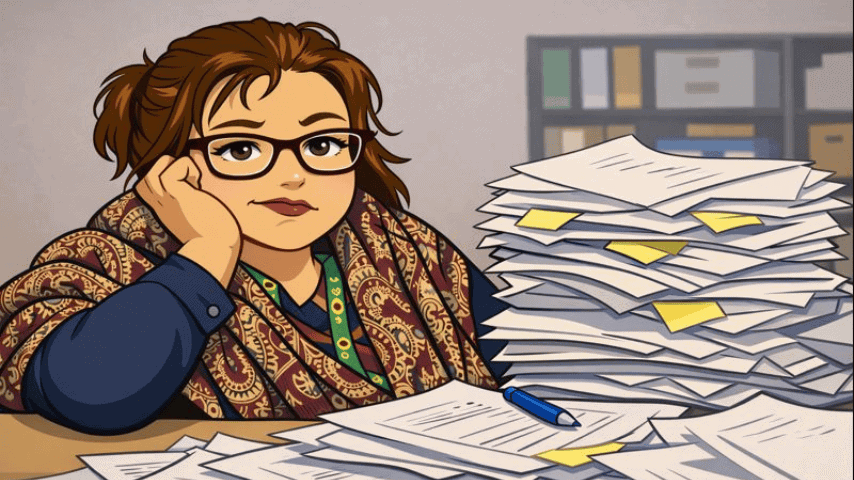
Part 1: The Hidden Labour of Survival
There is a category of labour that never appears on a job description, yet for families like mine, it is a full-time occupation. It is the work of translation.I am AuDHD as are my children, my husband is also neurodivergent. Across healthcare, education, and welfare, I have spent my life translating my family’s basic human needs into a dialect that “The System” understands: forms, emails, explanations, and appeals. Often, this work goes unacknowledged. Often, it must be done three times over for different departments.
This isn’t a “rough patch.” It is the hidden architecture of survival.
A Week in the Life of “Capacity”
To understand the “Invisible Tax,” look at my current week. Alongside a demanding full-time job and several volunteer roles, I am currently:
- Chasing my child’s autism diagnosis, which is still “in process” three months after the actual appointment.
- Organising an ADHD medication review for another child.
- Meeting with a school to chase an Education, Health and Care Plan (EHCP) that has stalled.
- Trying to book access to attractions for the school holidays that must be pre-booked if you have access needs.
- Complaining about access promises that were disregarded by a major airline.
This is all before I have even considered my own neurodivergent needs or the sensory recovery time I require just to remain functional. For us, Executive Function—the mental skills used to plan, sequence, and maintain attention—is not a given; it is a finite resource consumed by the very systems meant to help us.
The Impossible Choice: Work vs. The System
The UK’s systems are failing to accommodate neurodivergent talent. Only 30% of autistic adults are in any form of employment, the lowest rate of any disability group (ONS, 2022). Furthermore, research found that nearly 25% of parents of disabled children have had to leave work entirely due to the lack of support and the sheer “admin” of their child’s care (Contact, 2023).
The Deadly Cost of Not Being Heard
This isn’t just about stress; it is a matter of life and death. Autistic people die, on average, 16 to 22 years earlier than the general population (University College London, 2023). They are significantly more likely to die by suicide—a risk heightened by the “double empathy” gap and the trauma of being repeatedly ignored by service providers. We should be blaming the load. When a system refuses to listen, the load becomes a lethal weight.
I need to acknowledge my privilege.
I am white.
I am educated and articulate.
I am financially stable enough to survive delays.
I have a supportive partner.
I work in an environment that understands neurodivergence in practice.
I am supporting this project not because my experience is the worst, but because it is recognisable. Because collective understanding is often the only thing standing between a person and collapse.
If these barriers exist for me and my children, they will be even steeper for those with fewer resources, less confidence, or less support.
I made it through 2025 because I did not do it alone.
That is not a success story.
It is exactly why this project matters.
Even with all of that, 2025 nearly broke me. In part two I’ll outline some of those specific challenges.