
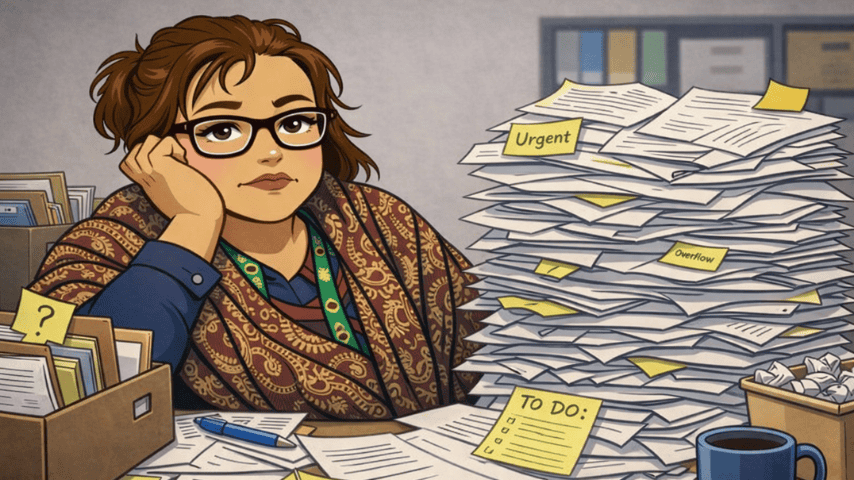
How 2025 nearly broke me
If Part 1 is the weight of the work, Part 2 is what happens when that work is met with systemic silence or hostility. These aren’t isolated incidents from a distant past; these have all hit my family in 2025 alone. Often, these battles are not sequential—they are happening simultaneously
A note on privacy
I have removed or generalised many details about my children in this account in order to protect their privacy. This does not dilute the reality of what occurred.
If anything, the omissions understate the impact. The full version of events involves repeated failures, prolonged distress, and consequences that are difficult to describe without causing further harm.
This is not hyperbole. It is a careful and partial telling.
Healthcare: when process failure becomes personal
One of the most damaging battles of 2025 played out quietly, through emails that were not sent, systems that would not accept messages, and long stretches of silence.
In autumn 2025, I completed ADHD titration with a Right to Choose provider. A shared care request was submitted to my GP surgery, a practice that had supported the original referral.
Weeks later, I received an email from the specialist provider informing me that shared care had been refused.
What I did not receive was any communication from my GP surgery.
No explanation.
No notification.
No information about what would happen next.
I tried to contact the surgery over the weekend, not expecting a response, but needing to send the message while I had the capacity to do so. The online system did not allow messages to be submitted outside working hours.
When I tried again, the online form imposed a strict character limit, far too small to explain a situation involving medication continuity and disability-related access needs. I used the space simply to ask for an email address so I could write properly.
I was told there was no email address.
If I wanted to complain, I would need to do so on paper.
In 2025.
So I printed, wrote, and physically hand-delivered a formal complaint. It covered the refusal of shared care without explanation, failures in communication and accessibility, and concerns under the Equality Act and the NHS Accessible Information Standard.
Then nothing happened.
Days passed with no acknowledgement. When I phoned to ask whether the complaint had been received, no one could tell me. Eventually, I received a text saying it had been “received” several days later, contradicting the date I had hand-delivered it. There was no explanation.
I contacted the Integrated Care Board. I was told they could not intervene because the practice had acknowledged the complaint. Escalation routes existed, but the timescales, many months, were entirely incompatible with the reality that this involved controlled medication.
During this time, responsibility for prescribing sat in a gap between systems. I went without medication for several days, not because anyone had decided to stop it, but because no one had taken ownership.
Separately, one of my children required routine physical monitoring in order to proceed safely with ADHD assessment and treatment. Accessing this was unexpectedly difficult. Community options were unsuitable, equipment was not appropriate, and appointments were not available in a workable way for something required regularly.
At one point, the specialist provider considered removing my child from their waiting list because required information could not be supplied, until I explained again that the barrier was not refusal or neglect, but lack of access.
Education: when difference is considered danger
Earlier in the year, I was contacted by one of my children’s schools about a referral for Early Help support. I welcomed this. I had raised concerns about anxiety and wellbeing for some time and assumed the referral was about support.
When I later saw a copy of the referral, I noticed that it focused on certain practical concerns but omitted key contextual information, including existing neurodevelopmental diagnoses.
Weeks later, during a direct conversation with Early Help, I learned that the referral had been made on the basis of suspected neglect.
This was the first time I had heard that word applied to my parenting.
No one had discussed this with me beforehand. Not the class teacher. Not the SENCO. Not the safeguarding lead.
When I asked what concerns had been recorded, I was told I would need to submit a Subject Access Request and would receive the relevant safeguarding records within a week.
That did not happen.
Weeks passed. I followed up repeatedly. There were references to “complications” but no explanation, no clarity, and no timeline. During this period, concerns about my child were logged in safeguarding systems and shared externally, while I, as their parent, was unable to see them.
Eventually, I had to escalate through my MP, senior leadership within the academy trust, and the Information Commissioner’s Office to access a redacted version of the records.
If the school genuinely believed there were safeguarding concerns, they had a duty to raise them directly with us. Escalating without discussion and then withholding information fundamentally undermined trust.
At the same time, I encountered a smaller but telling example of how procedural rigidity compounds harm.
The county council requires parental consent forms in order to provide additional support for neurodivergent children. In one case, a digitally signed form was submitted and accepted without issue. In another, an identical form, signed in the same way for a different child, was rejected on the basis that it required a manual signature.
Both forms were submitted to departments within the same council. Both related to neurodivergent support. No explanation was given for the discrepancy, and no allowance was made for the access needs that digital signing is meant to support.
The effect was not just delay, but disorientation. Help existed. Consent had been given. But the rules appeared to change depending on which part of the system you reached.
It was difficult not to think of Kafka, not because the situation was dramatic, but because it was banal, opaque, and entirely indifferent to the human effort required to comply.
This was not an isolated experience. There had been earlier incidents involving inappropriate questions about my disability and my ability to parent, communication via individuals not listed as contacts, and references to decisions that appeared to have been discussed without my involvement.
Welfare: when disability is judged by appearances
My interactions with the benefits system in 2025 reinforced the same message. If your disability is not obvious, constant, or easily measured, it is treated as suspect.
An application for Disability Living Allowance for one of my children was refused, despite their need for significant day-to-day support. Their needs are quieter, less disruptive, and easier to miss, except at home, where distress can be intense and prolonged.
A mandatory reconsideration was requested. Months passed. No decision arrived.
At the same time, I applied for Personal Independence Payment for myself. Not because I cannot work, but because disability carries additional costs.
For example, I buy lunch at work every day. On paper, bringing a packed lunch sounds simple. In reality, it requires planning, sequencing, remembering, preparing, packing, and remembering again, all areas affected by ADHD. Buying lunch is not a luxury. It is an adaptation that allows me to function consistently enough to stay employed.
Some adaptations are invisible. Replacing specialist clothing more frequently due to sensory needs. Paying for predictability, flexibility, and recovery.
My assessment resulted in zero points.
Because I have a degree and a job, I was deemed not disabled.
The assessment report also contained factual inaccuracies and conclusions that reflected a fundamental misunderstanding of ADHD. Knowledge was treated as evidence of executive function. Capability in one context was assumed to translate reliably to all others.
Once again, the burden sat with me to challenge errors, request reconsideration, and wait months more.
Travel and leisure: independence, joy, and systemic friction
Despite everything, my children and I set ourselves a challenge in 2025: to have 100 adventures together. We ended the year having exceeded that goal.
These trips were the highlights of the year. But even here, accessibility systems sometimes invalidated us.
Adjustments existed, but information was not shared proactively. Hidden disability markers were inconsistently recognised. Access depended on knowing the right language, the right process, or the right person to ask.
More difficult was the frequent requirement for a “carer” in order to access adjustments. As a neurodivergent adult who benefits from sensory accommodations but does not require supervision, this framing felt exclusionary. Needing adjustments does not mean lacking independence.
Across different venues, access systems varied widely. Some worked well. Others required advance booking months ahead, creating significant executive function barriers. Planning spontaneity out of family life may look reasonable on paper, but it is not accessible in practice.
Staff were kind. Systems were well-intentioned. But accessibility that depends on advanced planning, hidden rules, or proving dependency still excludes many neurodivergent people.
What looks like withdrawal is often overload. What looks like non-compliance is often exhaustion.
Why the Neurodivergence Project Matters
Nothing about this was caused by malice. Staff were often kind. But kindness does not compensate for systems that depend on people quietly absorbing harm.
None of the incidents described here are isolated.
There are other examples I have not included. There are earlier years I have not written about. And there are countless similar stories shared, quietly and repeatedly, by neurodivergent friends navigating the same systems.
What has kept me sane is not resilience in isolation, but community.
It is the steady support of other neurodivergent adults who understand without explanation. Friends who sanity-check letters, help draft complaints, share scripts, compare notes, and remind each other that what we are experiencing is not personal failure, but systemic design.
The Neurodivergence Project exists to ensure that all neurodivergent people can find their tribe, and feel supported.