
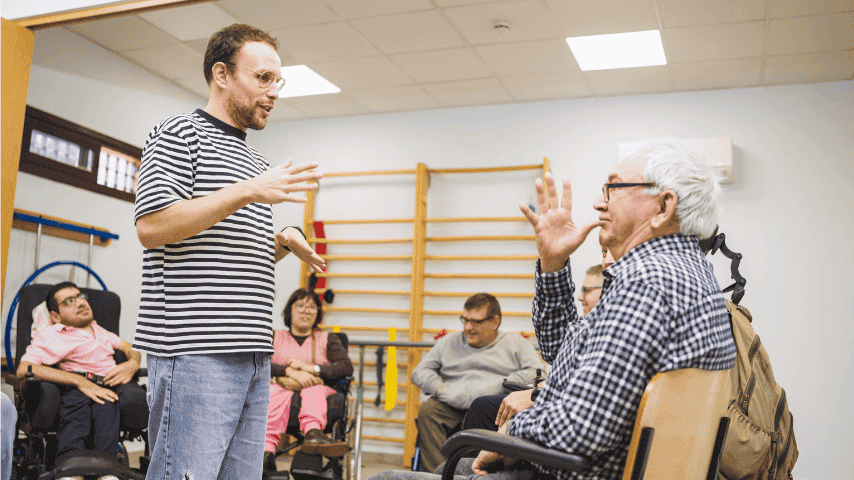
Lived Experience Leadership is not just a concept or a framework. It is a shift in power, voice, and value.
It starts from a simple but often overlooked truth. The people who experience systems, barriers, and challenges first-hand are often the people best placed to shape how those systems should change.
Through my work in creating the Lived Experience Leadership, I am building a space that centres real stories, real voices, and real insight from people who have lived through disability, health conditions, neurodivergence, and barriers in education, employment, and everyday life.
This is not about speaking for people. It is about creating platforms where people can speak as themselves and be listened to properly.
Too often, decisions are made about communities without those communities being meaningfully involved. Lived Experience Leadership challenges that. It brings people into the centre of decision-making, design, and change. It values insight that does not always come from data or policy papers, but from real life.
And that is where real transformation begins.
Why Lived Experience Leadership is so important
Lived Experience Leadership matters because it changes what “expertise” means.
Traditional systems often prioritise qualifications, professional roles, and institutional knowledge. While these are important, they can miss something essential. What it actually feels like to navigate those systems.
Lived experience adds context that cannot be taught in a textbook.
It shows where systems work on paper but fail in practice. It highlights barriers that are invisible in reports. It reveals solutions that only become clear when you have lived through the problem yourself.
When lived experience is included properly, services become more human. Policies become more realistic. Support becomes more effective.
Most importantly, people feel seen, not just assessed or categorised.
My own lived experience
This work is not theoretical for me. It comes directly from my own lived experience of navigating systems that were not always designed with people like me in mind.
I am deaf, and I also live with health conditions and disabilities, including epilepsy. These experiences have shaped not only how I move through the world, but how I understand inclusion, communication, and access.
There have been many moments where communication barriers have created isolation, not because people didn’t care, but because systems were not set up to fully include deaf people in a meaningful way. Something as simple as access to information, fast-paced environments, or group communication can become a barrier when adjustments are not in place or understood.
Alongside this, living with epilepsy has added another layer of unpredictability and invisibility. It is not always visible to others, but it can have a significant impact on confidence, independence, and how safe you feel in different environments.
Over time, I also began to recognise the way these experiences are often misunderstood in professional or educational spaces. Too often, decisions are made without truly understanding what day-to-day access actually looks like. That is where frustration comes in, but also where purpose began to form for me.
My journey into creating Lived Experience Leadership came from that space. Not just from experiencing barriers, but from recognising that those barriers could inform better ways of designing education, employment, and support systems.
I have also worked directly in health and social care, supporting adults with disabilities to build independence. That experience showed me something powerful. That when people are given the right support, environment, and belief in their abilities, they don’t just participate, they thrive.
That combination of personal lived experience and professional practice is what drives my work today.
It is why I focus on creating spaces where people are not just “supported,” but genuinely included and heard.
Lived Experience Leadership and the Neurodivergent Community
One of the most powerful examples of why lived experience leadership matters is within the neurodivergent community.
Neurodivergent people, whether autistic, ADHD, dyslexic, or with other cognitive differences, experience the world in ways that are often misunderstood, oversimplified, or misrepresented.
For far too long, narratives about neurodivergence have been shaped without enough input from neurodivergent people themselves. This has led to systems that focus heavily on “fixing” or “managing” differences, rather than understanding, supporting, and valuing them.
Lived experience leadership changes that.
It centres neurodivergent voices in conversations about education, employment, accessibility, mental health, and inclusion. It asks a simple but powerful question.
What actually works for you, based on your lived reality?
And the answers are often transformative.
Neurodivergent individuals bring unique strengths, perspectives, and ways of thinking that can reshape how we design learning environments, workplaces, and communities. From creative problem-solving and pattern recognition to deep focus, innovation, and different communication styles, there is enormous value that is often overlooked when systems are too rigid.
But to unlock that value, we have to stop treating neurodivergence as something to be “managed” and start recognising it as something to be understood, supported, and included from the start.
Why sharing lived experience matters
Sharing lived experience is not about telling individual stories for sympathy or awareness alone. It is about influence.
It is about shaping better decisions, better services, and better understanding.
When neurodivergent people share their experiences, they are not just describing challenges, they are offering insight into how systems can improve. They are showing what inclusion actually looks like in practice, not just in policy.
And when those voices are consistently included, changes can happen:
- Education becomes more flexible
- Workplaces become more accessible
- Conversations become more honest
- And people stop being treated as problems to solve, and start being recognised as people to understand
Moving forward
Lived Experience Leadership is about building something bigger than individual stories.
It is about collective voice.
It is about creating spaces where people with lived experience are not just invited into the conversation but are helping lead it.
This is especially important in the neurodivergent community, where so much potential is still being overlooked simply because systems were not designed with different ways of thinking in mind.
My aim through this work is to help shift that. To support a culture where lived experience is not an add-on, but a foundation.
Because real inclusion does not happen when people are adapted to systems.
It happens when systems are adapted around people.
By Matt Gurr
Employability Trustee